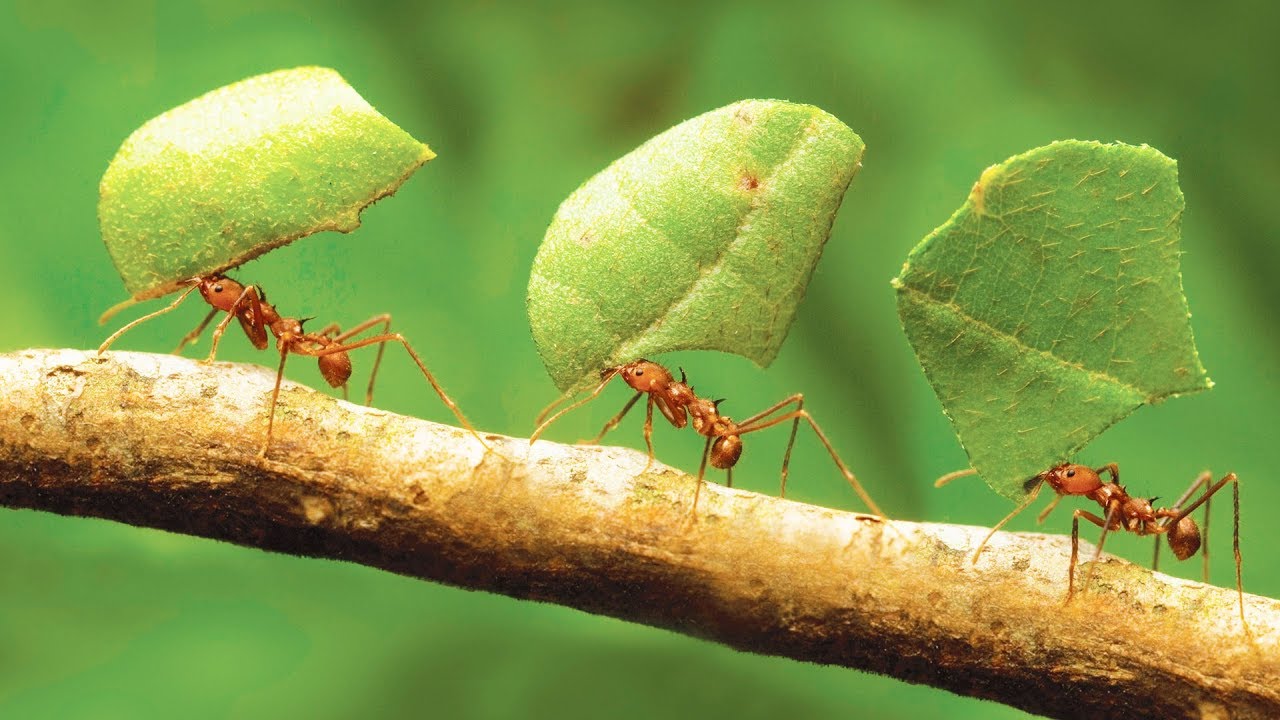
You’ve probably already seen — at least in a video — those iconic endless lines of ants tirelessly carrying leaves to some mysterious destination. These ants, commonly known as “leaf-cutters,” are in fact fungus-growing ants! They do not eat the leaves they tirelessly bring back to their nests. Instead, they chew them and use the pulp as a substrate for a cultivated fungus, which they harvest sparingly because it is their main source of food.
This system is one of the rare examples of non-human agriculture, a mutualism so advanced that it has led to a remarkable co-evolution between insects and fungi. Their societies are often compared to an “underground civilization,” structured around gigantic gardens, sophisticated ventilation, and living highways.
Genus and distribution
Fungus-growing ants are represented by two genera: Atta and Acromyrmex. Both belong to the family Myrmicinae and the tribe Attini. This tribe includes all the so-called “leaf-cutting” ants — but not only! It also includes widespread genera such as Pheidole (e.g., Pheidole pallidula, common in the Mediterranean region) and Wasmannia (e.g., Wasmannia auropunctata, an invasive exotic species in many countries, including France for the past three years).
Despite their close phylogenetic relationship, Atta and Acromyrmex show clear morphological and behavioral differences.
For example, Atta workers have two pairs of spines, whereas Acromyrmex have three or four.
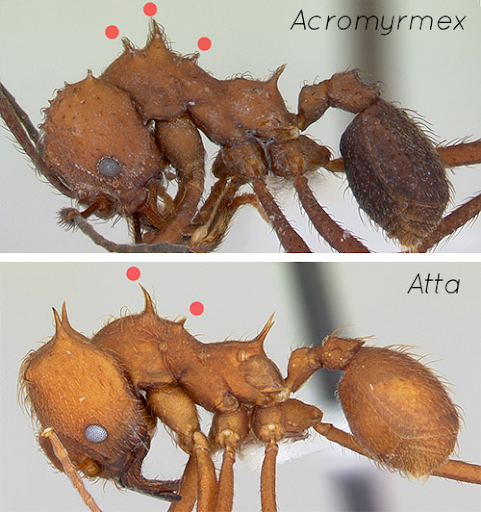 Binocular-microscope image of an Acromyrmex worker (top) and an Atta worker (bottom).
Both genera cultivate a fungus by adding organic matter — usually leaves or petals — but Acromyrmex workers tend to pick up debris from the ground rather than cut fresh leaves like Atta. Their nests are smaller and less populous. Both cultivate fungi of the genus Leucoagaricus, though cultivation is far more intensive in Atta.
Indeed, the genus Atta forms some of the largest colonies in the ant world, with nest surfaces spanning several dozen square meters and underground networks extending several meters deep. Each colony mobilizes millions of individuals that drastically reshape their environment.
As we will see in the next chapter, Atta exhibit extreme worker specialization with pronounced social polymorphism. In Acromyrmex, caste distinctions are subtler.
Both genera are found in tropical forests of South and Central America up to the southern United States. They thrive where organic matter is abundant. Acromyrmex, however, has a wider distribution and can occupy more “austere” habitats — arid or colder regions, pampas, and even Andean environments with large thermal fluctuations, where Atta becomes rare.
These ants can also become serious agricultural pests. Their massive, voracious colonies harvest impressive quantities of plant matter: young shoots, fruit-tree leaves, food crops… In parts of South America or the Caribbean, they cause significant economic losses.
In Guadeloupe, for instance, the “manioc ant” (Acromyrmex octospinosus) is notorious for rapidly defoliating cassava, citrus, and banana crops, forcing farmers to implement constant control measures. It is one of the rare invasive leaf-cutting ants, introduced accidentally in the mid-19th century. Their success stems from their social organization, extensive nest networks, and rapid reproduction, making them difficult to control without harming the environment.
In the following sections, we will focus primarily on Atta.
Organization and morphology
Growing a fungus at this scale is no small task… Workers contribute according to their caste.
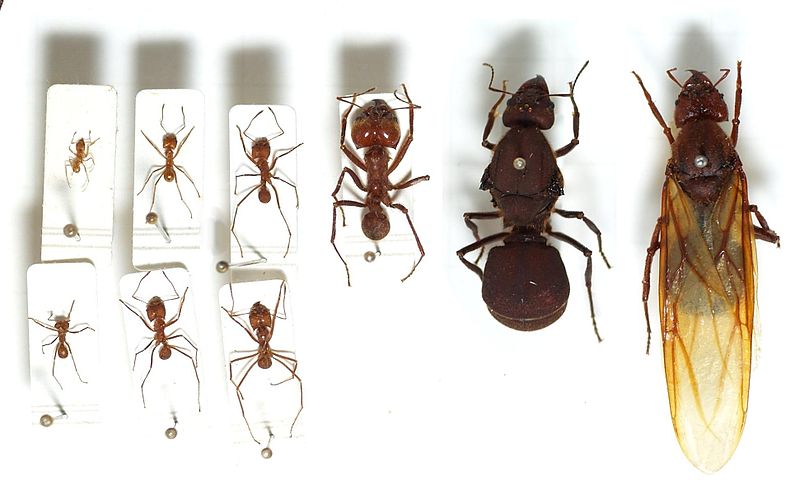
Photo showing different castes of Atta ants, from left to right: minor, media, major, and queen.
In Atta, minor workers (2–5 mm) tend the fungus directly. Their small size allows them to move through the tiny cavities of the fungal mass. They also care for the brood and maintain nest hygiene.
Atta display a unique behavior: minors sometimes ride on leaves carried by media workers to remove parasitic fungal spores on the spot — they act as living sentinels.
Media workers (5–10 mm) handle tasks requiring more strength: harvesting, gathering leaves, nest construction, and repairs.
Major workers, the “soldiers,” defend the nest and the living highways formed by the ants. They are easily identified by their massive heads, which house powerful mandibular muscles. They are often seen guarding the periphery of the leaf-transport lines.
Although these ants show one of the most advanced forms of social organization, it is not as rigid as human societies. Minors may help with nest building, media may tend the fungus, etc. However, social polymorphism remains extremely pronounced, with workers varying massively in size (sometimes six distinct worker sizes), each fulfilling a specific role: grinders, harvesters, heavy carriers, cleaners, gardeners, and defenders.
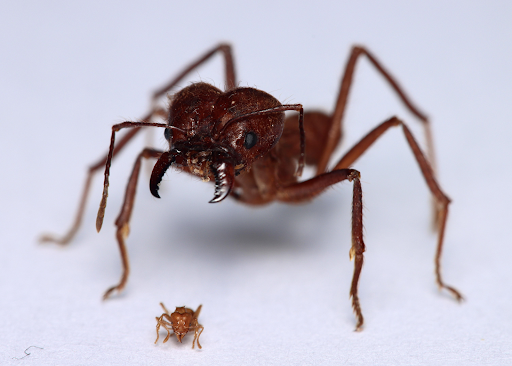 Photo of a major Atta cephalotes
And the queens are among the largest ants in the world, reaching over 2 cm in length.
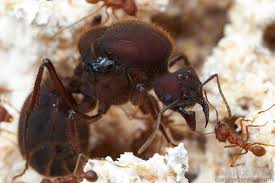
This organization stems from precise control by the queen and nurse workers over larval nutrition. Depending on the nutrients provided, a larva may become a tiny minor or a gigantic major. Yet all workers are identical at the egg stage.
History and dispersal of the fungus
As mentioned earlier, the cultivated fungi belong to the genus Leucoagaricus. These strains are no longer found in the wild. The cultivated fungus has evolved to produce gongylidia, small grape-like nutrient-rich structures full of lipids and sugars, specially designed to feed the ants. These structures do not exist in any wild fungus.
Like human crops bred for high yield but dependent on cultivation, these fungi cannot survive without the ants. They require extremely high humidity and constant high temperatures. Ant nest architecture maintains these conditions — especially important because the fungus emits large amounts of CO₂. Without proper ventilation, the ants would suffocate.
There is also a third major partner in this mutualism: an antiparasitic bacterium of the genus *Streptomyces**, cultivated by the ants. It protects their fragile fungal gardens from pathogens. Gardeners constantly inspect the fungus with their highly sensitive antennae, capable of detecting minute chemical changes. A slight odor shift is enough to signal a parasite or physiological stress.
When a future queen leaves the nest to start a new colony, she carries a fragment of her mother colony’s fungus in a special pouch beneath her mouth: the infrabuccal pocket, a remarkable anatomical adaptation.
If she succeeds, this fungal “cutting” becomes the nutritional foundation of her future colony. Thus, fungal lineages mirror ant lineages. If the fungus fails, the queen — and her entire future colony — are doomed.
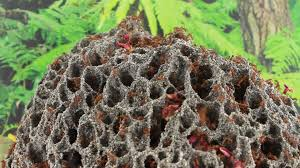
This is true domestication of a fungus by ants. Genetic studies suggest that leaf-cutting ants and their cultivated fungi have been associated for over 15 million years, forming an evolutionary bond comparable to ancient human agriculture.
Ecological, cultural, and economic importance
Fungus-growing ants play a major ecological role. A mature Atta colony can harvest up to 15% of a tropical forest’s annual leaf production.
Far from destroying the forest, this constant recycling stimulates vegetation growth, aerates the soil, and locally enriches it with organic matter. They are considered ecosystem engineers, modifying their environment in ways that can benefit or harm other species.
Their massive nests alter soil hydrology: the thousands of tunnels improve water infiltration and reduce erosion. Some plants even grow preferentially in Atta-modified soils.
Culturally, leaf-cutting ants play a role in the traditions of several Indigenous Amazonian peoples. Some species are consumed grilled (especially the large queens) or used in traditional medicine.
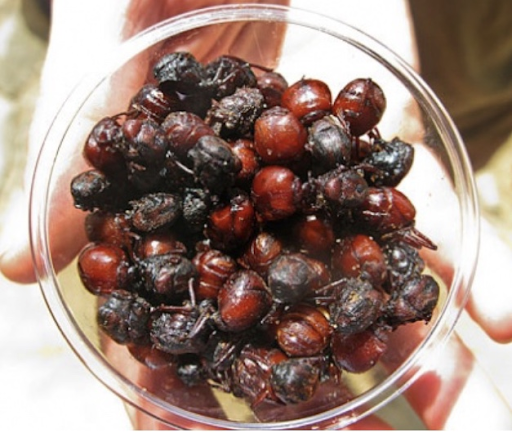 Roasted queens of Atta laevigata after immersion in salted water.
Economically, Atta species can be devastating agricultural pests. They target a wide range of crops: citrus, cocoa, mango, banana… Some South American farms lose up to 20% of production due to nearby colonies. Their organization and collective strength make control extremely difficult.
A super-organism farmer — agriculture before humans?
Fungus-growing ants represent the most advanced form of non-human agriculture known. Several features make it a complete agricultural system:
Production
They collect substrate, transform it, regulate its quality, and maintain continuous production.
Selection
Colonies eliminate fungal strains that are unproductive or infected, preserving an optimized lineage.
Health and hygiene
Their cultivated Streptomyces act as an internal pharmacy, producing natural antibiotics.
Generational transmission
The fungal “seed line” is passed from mother to daughter: the queen carries a cutting from her natal colony.
“Agro-industrial” architecture
Atta nests include dedicated chambers: cultivation rooms, brood chambers, waste disposal sites, ventilation tunnels, sorting areas… A miniature agro-industrial complex.
Behavioral and genetic adaptation
Mutualism has shaped both the fungus and the ants: the fungus produces specialized nutritional organs, and the ants evolved highly specialized castes to cultivate it.
Conclusion
The history of fungus-growing ants shows that agriculture is far older than we usually imagine. Long before the first humans planted seeds, these insects had already invented a sophisticated form of farming.
Phylogenetic analyses indicate that the ancestor of attine ants (the group including Atta and Acromyrmex) began cultivating fungi 50–60 million years ago. Intensive farming lineages, including Atta and Acromyrmex, emerged 15–20 million years ago.
For comparison, human agriculture appeared only 10,000–12,000 years ago. This means ants have been farming their fungi 5,000 times longer than humans have cultivated wheat, rice, or maize.
Despite the vast evolutionary distance between us, there are remarkable convergences between our agricultural systems.
Watching an Atta colony at work feels like observing a miniature version of our own agriculture, where each worker — from tiny gardener to colossal major — contributes to a meticulously coordinated system. It is a form of agriculture fully integrated into the living world, where individual specialization supports every step of the process.
Perhaps that is what makes fungus-growing ants so captivating: they show that agriculture was not invented by humans, but is a biological principle of which we happen to be among the most recent practitioners.