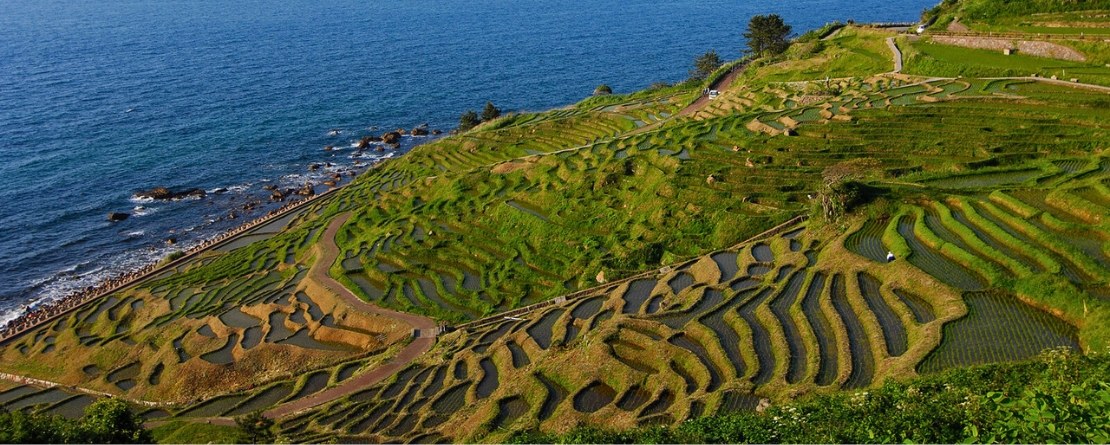
Satoumi is a unique concept in the world, promoting the sustainable management of coastal natural environments…
Introduction
In coastal areas around the world, human activities such as industrial fishing, urbanization, and pollution are damaging some of the richest and most fragile ecosystems on the planet. Seas and coastlines often become zones of conflict between economic development and environmental preservation. Faced with this tension, a fundamental question arises: can we live with the sea without destroying it? Japan, an archipelago deeply connected to the ocean through its history, culture, and economy, offers an original answer through a concept rooted in its traditions: Satoumi.
Far from being just a word, Satoumi embodies a philosophy of coexistence between human societies and coastal marine environments. It refers to coastal areas where human intervention does not reduce biodiversity but instead enhances it, provided that such intervention is guided by collective management and a long-term vision.
Born from empirical observations and practices passed down through generations in Japanese fishing villages, Satoumi was redefined and promoted by scientific research at the end of the 20th century. Today, it represents a model of sustainable management that increasingly attracts researchers, marine protected area managers, and coastal communities worldwide.
This model challenges the widespread idea that humans must distance themselves from nature to protect it. On the contrary, Satoumi proposes a path of active involvement, locally rooted in production systems, where conservation is achieved through human participation rather than withdrawal.
In this article, we will explore what the concept of Satoumi encompasses, how it works, its historical and cultural roots, and why it is now a source of inspiration for rethinking our relationship with seas and coastlines.
What is Satoumi?
The term Satoumi (里海) comes from two Japanese words: sato (里), meaning “village” or “inhabited place,” and umi (海), meaning “sea.” Literally, “Satoumi” refers to a coastal sea shaped by human presence—but in a positive way. Contrary to the common belief that human activity degrades the environment, Satoumi is based on the principle that human intervention, when respectful and well-managed, can enrich biodiversity and ecological functions compared to conventional exploitation systems.
Origins of the concept
The term was formalized in 1998 by Professor Yanagi, but the associated practices are much older. They stem from traditional fishing and coastal management practices observed for centuries in Japanese villages. Coastal communities lived in close relationship with their environment, engaging in activities such as:
- Seaweed and shellfish farming,
- Collective management of fisheries,
- Maintenance of upstream forests (called satoyama), which influence coastal water quality.
Satoumi is therefore both a cultural heritage and a modern reinvention of ecological management.
Structure and functioning
A Satoumi is not a “wild” natural area but an anthropogenic ecosystem, meaning it is influenced by human activity. It is characterized by:
- A close interaction between sea and land: forests, rivers, wetlands, and bays form an inseparable whole.
- Community-based management of natural resources: fishers, farmers, residents, scientists, and authorities cooperate to maintain ecological balance.
- Increased biological and functional diversity: studies have shown that some Satoumi areas have higher biodiversity than strictly protected environments, thanks to habitat maintenance and invasive species control.
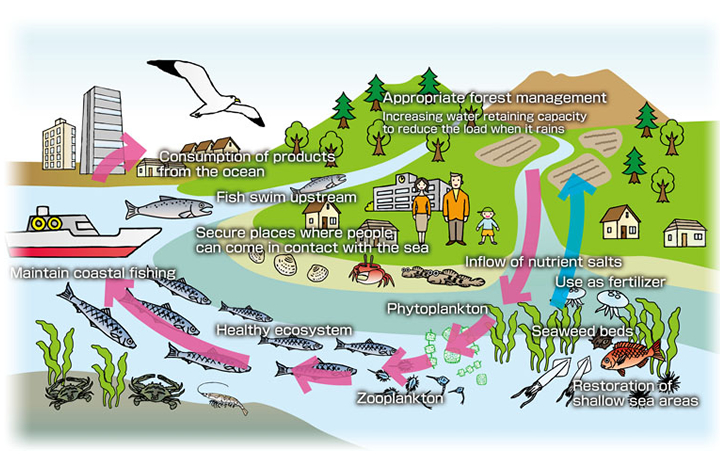
A typical example of Satoumi
Obama Bay, in Fukui Prefecture, is often cited as a model. There, the restoration of upstream forests has improved seawater quality, encouraging the return of marine species that had previously disappeared. Fishing cooperatives apply traditional rules for sustainable resource use.
Evolution and international recognition
Since the 2000s, Satoumi has gained increasing international attention, particularly through the Japan Satoumi Policy initiative launched in 2006 and its recognition by the Convention on Biological Diversity (CBD).
Satoumi has been integrated into the Satoyama Initiative, supported by the United Nations, which aims to promote sustainable landscapes worldwide. It now serves as a model for other coastal regions, particularly in Southeast Asia and West Africa.
Long considered a simple rural heritage, Satoumi is now being re-evaluated as a living ecological and cultural asset. It embodies a philosophy of coexistence between humans and nature, quite different from Western approaches of “preservation at a distance.”
Current challenges and future
Satoumi is not fixed in the past. Today, it faces several challenges:
- Aging rural populations and the loss of traditional knowledge,
- Marine pollution from plastics and chemicals,
- Climate change, which alters ecological balances and current patterns.
In response to these threats, Satoumi is evolving: researchers and citizens are developing digital ecological monitoring tools, educational programs, ecological restoration projects, and partnerships with other integrated management models.
Conclusion
At a time when environmental crises are multiplying, Satoumi offers a valuable lesson in balance between humans and nature. Far from the logic of separating “natural” and “humanized” spaces, it invites us to rethink our way of inhabiting the world: not as intruders in ecosystems, but as responsible actors capable of caring for them.
Satoumi is not limited to a coastal management model; it represents a philosophy of connection, rooted in the daily lives of communities living by the sea. It emphasizes the transmission of local knowledge, cooperation between residents, scientists, and authorities, and the awareness that the health of the sea often begins on land—in forests, rivers, and villages.
This concept also reminds us that biodiversity is not only the result of “wild” nature, but also of sustainable interactions between humans and their environment. In this sense, Satoumi transcends Japan’s borders and resonates with other traditional approaches worldwide, such as Indigenous “territories of life,” agro-silvo-pastoral systems, and historical forms of local resource governance.
Today, as technical solutions to the ecological crisis struggle to take root locally, Satoumi shows that it is possible to act differently: through observation, collective participation, and mutual respect. This model is not frozen in the past; it continues to evolve with innovations, climate challenges, and new generations engaging with it.
Inspired by Satoumi, we could imagine new futures for our coastlines—living, shared, and resilient spaces, where we learn to inhabit the world in solidarity with other forms of life.